The BLC Blog

A forum and learning place for British Language Centre students

Monday, May 31, 2010

Word of the Week - 76

FAFF
This week's word is a colloquial noun which is used to describe something that needs a lot of effort or which causes slight problems.

Making your own pasta is a bit of a faff so I always buy it ready-made.

It can also be used as a verb to mean spend too much time doing something unimportant or unnecessary instead of doing the things you should be doing.

Stop faffing about and do your homework!
John has been faffing around with the car all day.

Labels: ,

Friday, May 28, 2010

What's the Difference - 8

ON TIME / IN TIME / BY THE TIME

ON TIME - means at the planned time; neither early nor late. Punctual.

It's always important to arrive on time to an interview if you want to make a good impression.
A typical stereotype about Spanish people is that they never arrive on time!

IN TIME - means with enough time to spare; before the last moment.

The man would have died if the ambulance hadn't got him to the hospital in time.
My car broke down on the motorway but luckily I got to the airport just in time to catch my flight!

BY THE TIME - means before the time that is specified.

I hope to be living in Santander by the time I am 40. (before I have my 40th birthday)
You'd better have cleaned the bathroom by the time I get home!

Labels: , , ,

Wednesday, May 26, 2010

Expression of the Fortnight - 17

BREAK A LEG!

This expression reflects a theatrical superstition where it is seen as bad luck to wish an actor good luck before he / she goes on the stage. Although it is more commonly used in theatre, it is also used more and more outside the theatre as superstitions and customs spread.

I thought since the Cambridge exams were coming up, I would take this opportunity to tell the students who are sitting an examination this June to Break a leg!

Labels: , , ,

Monday, May 24, 2010

Word of the Week - 75

CASE

This week's word is a very useful noun which can be used to make other compound nouns. A case is a container or box for storing things in. You can mix it with other nouns to make a wide variety of cases.

A suitcase is a type of bag that you fill with clothes when you go on holiday.
A briefcase is a type of bag that you keep work papers and documents in.
A pencil case is where you store your stationery when you go to school.
A bookcase is a piece of furniture with shelves where you keep books.
A pillowcase is a fabric cover for the pillows (almohadas) on your bed.
A glasses case is a small box for storing spectacles.
A guitar case is the box you keep your guitar in.

Labels: ,

Monday, May 17, 2010

Word of the Week - 74

SCRIBBLE
This week's word can be a verb and a noun. As a verb it means to write or draw something quickly or carelessly. As a noun it refers to the product of writing or drawing quickly or carelessly.

My son has scribbled all over my new wallpaper! Thank goodness those pens have washable ink!

I hope you can read my scribble! I wrote it in a rush this morning.

Labels: ,

Wednesday, May 12, 2010

Expression of the Fortnight - 16

to give something a shot

If you are prepared to give something a shot that means that you are willing to make an attempt to do something. If you give something your best shot it means that you are going to do your very best to achieve something.

I'm not really sure if it will work but I'm going to give it my best shot.
I've never played golf before but I'm going to give it a shot.
I'd like to give parachuting a shot.

Labels: , , ,

Monday, May 10, 2010

Word of the Week -73

TANTRUM

This week's word is a noun that is used to describe the sudden period of anger that a young child shows when they don't get what they want. It is most common in young children but some famous sportsmen have also been known to throw the odd tantrum. The American tennis-player John McEnroe was famous for his tennis tantrums. In fact, he appears in the film Anger Management with Jack Nicholson and Adam Sandler poking fun at his reputation! Youtube has some funny videos of McEnroe at his angry best.
The noun collocates with the verbs 'have' and 'throw'.
James threw a tantrum in the supermarket because I wouldn't buy him any sweets.
As I am writing this, my baby boy is having a tantrum on my lap because he wants to type and I won't let him.

Labels: ,

Wednesday, May 5, 2010

What's the Difference ? - 7

in the end / at the end / at last

At the end - when you use the preposition 'at' you are thinking about a specific point in time or a particular place.
At the end of the book they get married.
I'll wait for you at the end of the street.
I get paid at the end of the month.
There are also some set expressions using 'at the end':
At the end of the day
There's light at the end of the tunnel
At the end of one's tether
In the end - is used to mean finally or eventually, after something has been thought about, planned or discussed a lot.
We were thinking about going to Switzerland, but in the end we went to Austria.
In the end all that matters is that you're happy.
Everything will be alright in the end.
At (long) last - is used to mean finally when something ends or happens after a lot of waiting or working.
I've finished my essay at last!
Look, it's stopped raining at last!
At long last the government is starting to listen to our problems.

Labels: , ,

Monday, May 3, 2010

Word of the Week - 72

TIMBER

This week's word is an noun which I have taken from a news report from the BBC Learning English website. The word can be used in two ways. It can be used to refer to trees that are grown so that their wood can be used specifically for building material and it can be used to refer directly to the wood that is used for building. In American English this would be referred to as lumber and the person who chops down the trees to get the wood for building is called a lumberjack.

These trees are being grown for timber.
This is a timber forest.

And from the article I was reading...

There is an increased demand for food and timber.

To read the whole article follow this link >>>

Labels: , ,

Wednesday, April 28, 2010

Expression of the Fortnight - 15

TO BUTTER SOMEBODY UP
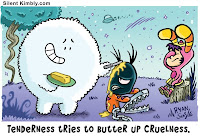
This fortnight's expression came up in class when one of my students was paying me a compliment. I wondered if my student had an ulterior motive for being so nice to me. I asked her if she was trying to butter me up! To butter somebody up is to be very kind or friendly to them or try to please them in some way so that they will do what you want them to do. Buttering somebody up is a way of manipulating them.
You'll have to butter her up a bit if you want her to agree to that!

Labels: , , ,

Monday, April 26, 2010

Word of the Week - 71

PECKISH

This week's word of the week was one of the solutions from a crossword I was doing - (those of you who know me will be aware that I'm partial to a good cryptic crossword). The word is an adjective which is used to describe how you feel when you are slightly hungry and would like a little something to eat. 'Rather' and 'a bit' are often placed before this adjective.

I'm feeling a bit peckish, can we go and get a bite to eat?

Even though I've had a huge breakfast and it's only ten o' clock, I have to admit that I'm feeling rather peckish.

Labels: ,

Monday, April 19, 2010

Word of the Week - 70

Whatsisname

This word of the week is related to last week's word in the way that it is used to refer to a person when you cannot remember or you do not know their name. In informal English -whatsisname or what's-his-name is used for men and whatsername or what's-her-name is used for women.

Have you invited Paul Whatisname to the party?

Give the file to whatsername - the new woman in Accounts.

Labels: ,

Wednesday, April 14, 2010

Expression of the Fortnight - 14

To be two-faced

If someone is two-faced it means that they seem pleasant and kind when they are talking to you but then behind your back they say unpleasant things about you to other people. A two-faced person is insincere.

I don't trust her. I suspect she is a bit two-faced.

Jacky is completely two-faced. She pretends to be your friend but then she bitches about you to other people!


Labels: , ,

Monday, April 12, 2010

Word of the Week - 69

THINGAMABOB

This week's word of the week is a noun. I absolutely love this word because it comes in handy when you can't remember the name of something and it sounds funny! It is especially used in informal spoken English when the name of an object has been forgotten.
I need one of those thingamabobs to tie my hair back with.
Have you got one of those thingamabobs to make melon balls?
You can also say thingamajig and it means exactly the same thing!

Labels: ,

Monday, April 5, 2010

Word of the Week - 68

GADGET

This week's word is a noun which is used to describe a device that is very useful for a particular job or purpose.

Have you seen this handy little gadget? - It's for separating egg yolks from egg whites.

My dad loves gadgets, he has allsorts of little toys for all kinds of jobs!

You could check out the Gadget Shop online to find out what gadgets are on offer! There is a whole range of goods from a self-stirring mug to a robotic dinosaur!

Go to the Gadget Shop >>>>

Labels: ,

Wednesday, March 24, 2010

Expression of the Fortnight - 13

TO HIT THE NAIL ON THE HEAD

The origin of this expression is not really known but it is a very old expression indeed -it was first found in a book from 1438. The expression is used to mean get to the precise point, the exact answer or to do / say something exactly right. The saying is very similar in Spanish 'dar en el clavo'.
I think John hit the nail on the head when he said what was missing in this company was a feeling of confidence.
Mary doesn't often contribute in meetings but when she does she usually hits the nail on the head!

Labels: , , ,

Monday, March 22, 2010

Word of the Week - 67

PROCRASTINATE
This week's word is a verb which means to delay doing something because it is boring or unpleasant or because you really don't feel like doing it. There is no direct translation in Spanish where the dictionary just says 'to leave something until later'. Although it also means that you do lots of other things, just not the productive thing that you are supposed to be doing!
I know I've got to write the essay at some point, I'm just procrastinating!
There is a funny article in Tony Buzan's book on becoming a better learner 'Use your head' which perfectly demonstrates the true meaning of procrastination. You can read it here > > > >

Labels: ,

Monday, March 15, 2010

Word of the Week - 66

HOBBLE

This week's word is a verb which means to walk in an awkward way or to walk with difficulty especially because of an injury of the leg or foot.
The last time I saw Fred he was hobbling around on crutches.
Some of the runners in the marathon could only manage to hobble over the finish line!
David Beckham hobbled off the pitch in tears, clearly aware that something was badly wrong.

To read the article related to the last example go to the BBC website here > > >

Labels: , ,

Thursday, March 11, 2010

Expression of the Fortnight - 12

GO DOWN LIKE A LEAD BALLOON
This fortnight's expression is used to refer to something that is not accepted in a positive way. If you say something or show something to people and they do not react as you had hoped then you can say that whatever it was went down like a lead balloon. (Lead (pronounced led) is a very heavy material). This expression is most commonly used in the past simple.
My joke about the alcoholic went down like a lead balloon!
My suggestion about increasing office hours went down like a lead balloon.
Well that went down like a lead balloon! (said by someone after delivering a presentation that wasn't well-received)
Story has it that Keith Moon of The Who, on hearing a song on the radio by Jimmy Page and his group the Yardbirds, said "That will go over like a lead zeppelin!". Obviously, he thought the song wasn't so good and that the general public wouldn't buy it. Of course, he must have been wrong because Jimmy Page and his band renamed themselves Led Zeppelin, who of course were very successful.

Labels: , ,

Monday, March 8, 2010

Word of the Week - 65

SHOWBIZ
Since the Academy Awards took place last night, I thought this Monday's word of the week should be related to the world of glamour and fame. Showbiz is a noun used in slang English for show business. Show business refers to the entertainment business.
In his Oscar acceptance speech last night, Jeff Bridges thanked his parents for introducing him to the world of showbiz.
The charity dinner was attended by a host of showbiz personalities.
I love reading trashy magazines and catching up on all the showbiz gossip!

Labels: ,